

Suzuki–Miyaura Coupling Reagents — A Comprehensive Collection for Cross-Coupling Chemistry
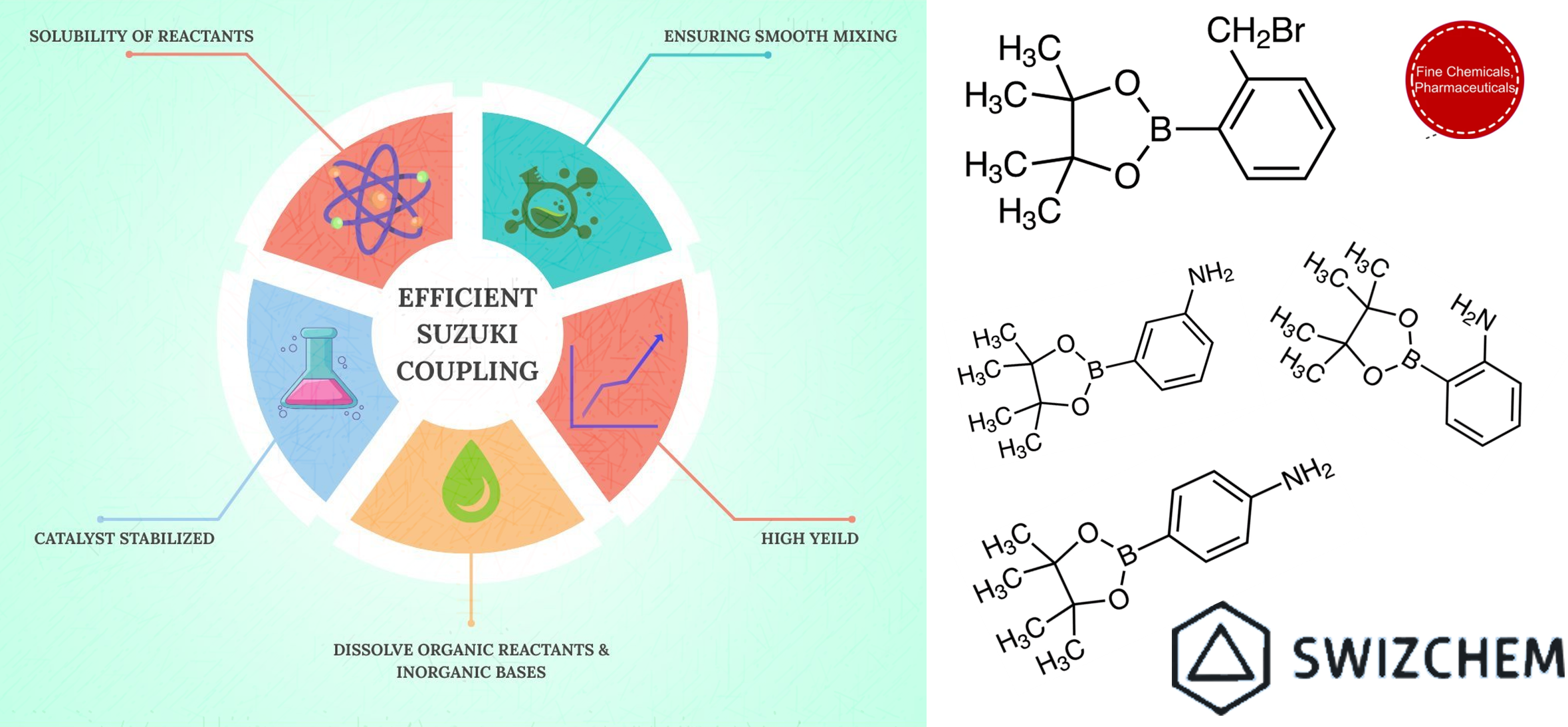
The Suzuki–Miyaura cross-coupling reaction is one of the most widely used transformations in modern organic synthesis. Its ability to form carbon–carbon bonds between aryl and vinyl halides and organoboron compounds under mild, tolerant, and operationally simple conditions has made it indispensable across medicinal chemistry, materials science, and the synthesis of complex natural products. The 2010 Nobel Prize in Chemistry recognised its transformative impact on the field, and its application in pharmaceutical synthesis alone spans hundreds of approved drugs, from cardiovascular agents to kinase inhibitors and beyond. Swizchem's Fine Chemicals catalogue now includes a dedicated collection of 25 Suzuki–Miyaura coupling reagents, carefully selected to provide broad and coherent coverage of the chemistry. The compounds are organised across four functional groups, each addressing a distinct aspect of cross-coupling workflows. Palladium and Nickel Catalysts. The choice of catalyst fundamentally determines the outcome of a cross-coupling reaction. Different metal centres, oxidation states, and ligand environments produce different levels of catalytic activity, selectivity, and functional group tolerance. Tetrakis(triphenylphosphine)palladium(0) — Pd(PPh₃)₄ is the most widely used palladium catalyst for Suzuki coupling, offering broad compatibility with aryl bromides and iodides. Bis(triphenylphosphine)palladium(II) dichloride is a Pd(II) precatalyst that is reduced in situ to the active Pd(0) species, offering improved bench stability. Tris(dibenzylideneacetone)dipalladium(0) — Pd₂(dba)₃ is a versatile precatalyst used with a wide range of ancillary ligands, particularly in reactions requiring bulky phosphine or N-heterocyclic carbene co-ligands. The dppf-based palladium complex, Pd(dppf)Cl₂·CH₂Cl₂, employs a ferrocene-based bidentate diphosphine ligand that provides a distinct coordination environment from monodentate triphenylphosphine, improving performance with challenging substrates including alkyl halides and sterically hindered aryl electrophiles. The corresponding nickel complex, dppf·NiCl₂, provides access to nickel-catalysed cross-coupling useful for cost-sensitive applications and substrates that respond better to nickel than palladium. Diboron Reagents for Borylation. Diboron reagents enable the conversion of aryl, vinyl, and alkyl halides into organoboron compounds via palladium-catalysed Miyaura borylation. The resulting C–B bond is a powerful synthetic handle that can subsequently undergo cross-coupling, oxidation to phenols, amination, or homologation, making borylation a critical enabling step in multistep synthesis. Bis(pinacolato)diboron — B₂pin₂ is the most widely used diboron reagent, offering excellent stability, solubility, and reactivity across a broad substrate scope. Bis(catecholato)diboron — B₂cat₂ shows distinct reactivity from B₂pin₂ in certain borylation reactions, particularly in metal-free radical borylation of alkyl and aryl iodides and in photochemical borylation protocols, opening access to reaction pathways not possible with the pinacol variant. Bis(neopentyl glycolato)diboron and Bis(hexylene glycolato)diboron complete the diboron set, offering structural variation around the boron centres that influences solubility, stability, and downstream handling properties. Monoboronic Acid Pinacol Esters. The catalogue includes a comprehensive and systematically varied set of arylboronic acid pinacol esters, covering a wide range of substitution patterns and functional group combinations. Phenylboronic acid pinacol ester provides the unfunctionalised aryl boronate reference. Bromophenyl variants at ortho, meta, and para positions allow direct comparison of steric and electronic effects and provide a halide handle for further functionalisation. Aminophenyl variants at all three positions introduce nitrogen functionality compatible with medicinal chemistry programmes. Bromomethylphenyl variants at ortho, meta, and para positions enable benzylic functionalisation chemistry. 4-Biphenylboronic acid pinacol ester extends the aromatic system for conjugated material synthesis. Ethynylboronic acid pinacol ester provides an alkyne-containing coupling partner for use in diverse downstream transformations. And (Dimethylphenylsilyl)boronic acid pinacol ester — Suginome's reagent — is a versatile silylborane that undergoes transition-metal-catalysed silaboration of carbon–carbon triple bonds, affording (Z)-1-boryl-2-silylalkenes with high regio- and stereoselectivity, and finds application in copper-catalysed synthesis of multi-substituted vinylsilanes. Diboronic Esters as Multifunctional Building Blocks. Diboronic esters carry two boronate groups, enabling sequential or simultaneous coupling reactions and the construction of extended molecular architectures. Their ability to participate in multiple coupling reactions makes them particularly valuable for building conjugated polymers, porous organic frameworks, and π-conjugated materials for organic electronic and optoelectronic applications. 1,4-Benzenediboronic acid bis(pinacol) ester provides a para-bifunctional phenylene building block. 4,4'-Biphenyldiboronic acid bis(pinacol) ester and its bis(neopentyl glycol) variant offer extended biaryl connectivity, enabling the construction of polyaryl structures with controlled conjugation lengths — particularly useful in light-harvesting and solvent adsorption material design. All 25 compounds are CAS indexed, HPLC verified, and supplied with a Certificate of Analysis. Global shipping is available for all catalogue items. For boronate esters, catalysts, or ligands not currently listed, Swizchem's custom synthesis service can deliver compounds to exact specifications and required purity standards.
Key Takeaways
- 25 Suzuki–Miyaura coupling reagents now available in Swizchem's Fine Chemicals catalogue
- Palladium catalysts including Pd(PPh₃)₄, Pd(dppf)Cl₂·CH₂Cl₂, Pd₂(dba)₃, and PdCl₂(PPh₃)₂
- Nickel catalyst dppf·NiCl₂ for nickel-catalysed cross-coupling reactions
- Four diboron reagents covering pinacol, catecholato, neopentyl glycol, and hexylene glycol variants
- Monoboronic acid pinacol esters with aryl, amino, bromo, alkynyl, and silyl functionalities
- Ortho, meta, and para substitution patterns for systematic electronic and steric comparison
- Diboronic esters for multifunctional coupling and conjugated polymer synthesis
- Suginome's reagent for silaboration of carbon-carbon triple bonds
- All compounds CAS indexed, HPLC verified, COA available, globally shipped
- Custom synthesis available for boronate esters outside the standard catalogue
The Suzuki–Miyaura reaction sits at the heart of modern synthetic chemistry and having the right catalyst, borylation reagent, or boronate ester building block directly determines how efficiently a programme moves forward. Swizchem's new collection of 25 Suzuki coupling reagents brings the full range of essential cross-coupling chemistry into one place, with the analytical verification and global availability that serious research programmes depend on. Browse the full catalogue at swizchem.com/products or contact us directly to discuss custom synthesis for compounds outside the standard range.